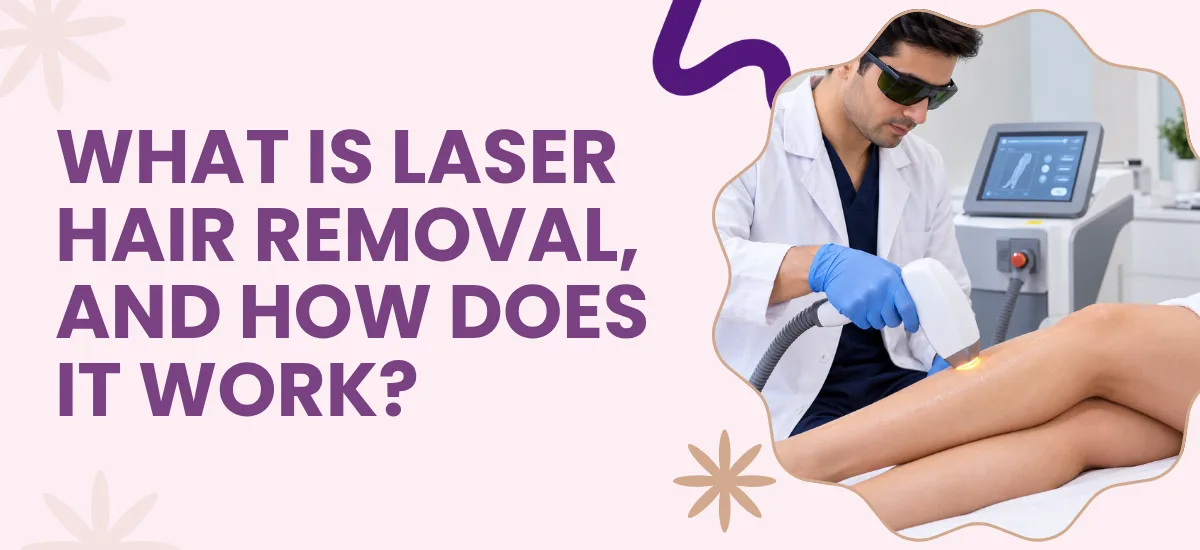

Laser hair removal works by targeting melanin inside the hair follicle with concentrated light, which converts to heat and damages the follicle’s ability to produce new hair. Unlike shaving or waxing, where hair simply grows back within days, this damage builds up across multiple sessions until growth slows significantly and, in many areas, stops almost entirely.
According to Dr. Jagatjit Singh Kohli of Agelock Skin & Hair Clinic in Chandigarh, “One session won’t finish the job and patients are often surprised by that. Hair cycles through active and resting phases and the laser can only catch what’s active right now. So you come back for the rest.”
Curious if laser hair removal suits your skin type? Book an appointment.
How Does Laser Hair Removal Actually Work?
One idea explains most of what happens during a session. Understanding it makes the whole process feel less like guesswork.
Selective Photothermolysis: Melanin in the hair absorbs the laser’s light and turns it into heat. That heat damages the follicle while the surrounding skin stays largely unaffected.
Growth Cycle Dependency: Hair on your body doesn’t all grow at once. Some follicles sit dormant while others stay active and only the active ones actually respond to a laser pass.
Skin and Hair Type Matching: Dark hair against light skin used to be the only reliable combination. That’s shifted quite a bit. Clinics now calibrate lasers for a far wider range of skin tones than they could a decade ago.
Session Spacing: Appointments land four to six weeks apart. That’s roughly the window it takes for a fresh set of follicles to cycle into their active phase.
This is why Laser Hair Removal in Chandigarh & Mohali treatment at our clinic is spread across multiple sessions rather than completed in a single appointment.
What Should You Expect From the Treatment Process?
Nothing about a session is particularly complicated. Knowing the steps ahead of time just makes it easier.
Pre-Treatment Prep: Staff clean the treatment area and shave down any visible hair first. The laser needs a clear path to the root rather than surface hair getting in the way.
During the Session: A handheld device passes repeatedly over the skin. Most patients describe it as a warm pinch or occasionally a light snap. Rarely anything beyond that.
Session Duration: An upper-lip clears in a few minutes. Full legs can stretch closer to an hour depending on coverage.
Aftercare Matters: Treated skin is more sensitive to UV exposure right after a session, so skipping sunscreen raises the risk of pigmentation changes or irritation in that area, not a loss of hair reduction itself.
Want the fuller picture, including the pros, cons and the full recovery timeline? This piece on what to expect during laser hair removal covers more ground than we can here.
Why Choose Dr. Jagatjit Singh Kohli for Laser Hair Removal?
Dr. Jagatjit Singh Kohli, an MBBS, DHMS-Harvard, with a Masters in Clinical Dermatology, doesn’t treat laser hair removal as one-size-fits-all. Skin tone, hair texture, how sensitive the skin is, each of these shapes the settings used at Agelock Skin & Hair Clinic Chandigarh. Get that calibration wrong, particularly on sensitive or deeper skin tones, and patients end up with irritation instead of results.
That’s really what to look for when searching for laser treatment in Chandigarh. Not every clinic bothers adjusting per patient, many just run the same protocol regardless of who’s in the chair. Call +91 98787 62626 to book your consultation.
Frequently Asked Questions
Is laser hair removal permanent?
Not with full certainty, though growth slows down considerably. A few stray hairs can still make their way back for some people.
How many sessions are typically needed?
Somewhere between six and eight, spaced a few weeks apart. Skip ahead too fast and the results won’t hold the way they should.
Does laser hair removal hurt?
Barely, if at all. The closest comparison most people reach for is a rubber band snap, nothing close to actual pain.
Is it safe for all skin types?
It is now. Older equipment struggled with darker skin tones, but today’s lasers adjust across a much wider range.
References:
- PMC (NCBI) — Attitudinal Trends and Misconceptions of Laser Hair Removal Among Dermatology Patients: https://pmc.ncbi.nlm.nih.gov/articles/PMC12210097/
- PMC (NCBI) — A Randomized Study Evaluating the Effectiveness and Safety of Laser Hair Removal: https://pmc.ncbi.nlm.nih.gov/articles/PMC13269859/
Disclaimer: This blog is for educational purposes only and isn’t a substitute for a dermatologist’s evaluation. Skin irritation, burns or unusual reactions after laser treatment should be assessed by a professional.